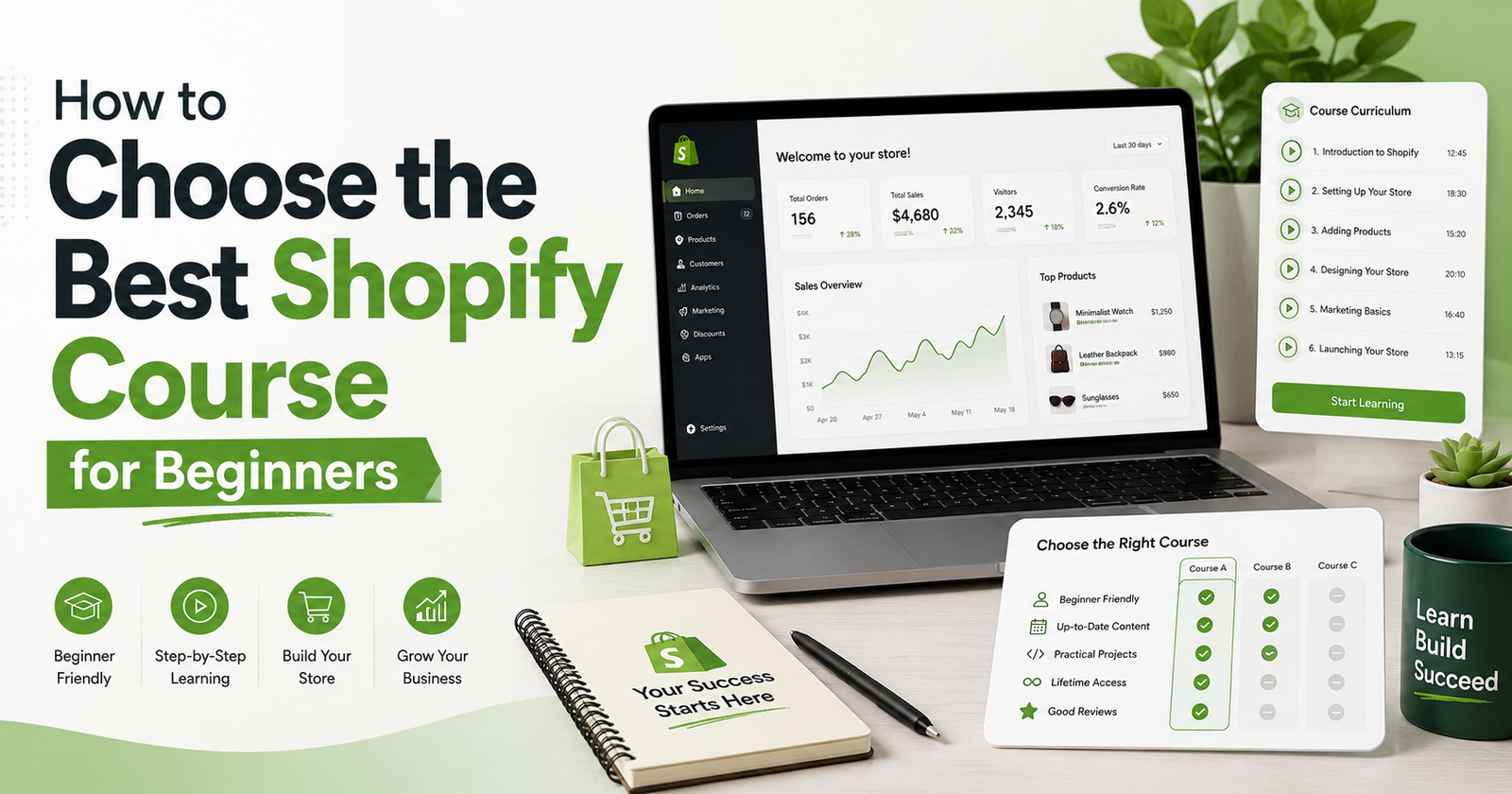
How to Choose the Best Shopify Course for Beginners
Introduction
Many beginners want to learn Shopify, but they feel confused when choosing a course. Some courses only teach basic store setup, some focus only on dropshipping, and some promise quick earning without proper skill-building.
This is why it is important to understand how to choose Shopify course before you spend your time or money.
A good Shopify course should not only teach you how to click buttons inside Shopify. It should help you understand ecommerce, build real stores, create a portfolio, and learn how to use Shopify as a skill for freelancing, business, or online earning.
In this guide, we will explain everything in simple words so even a beginner can choose the right Shopify course with confidence.
Why Choosing the Right Shopify Course Matters
Choosing the wrong course can waste your time. You may watch many lessons but still feel confused because the course does not follow a proper roadmap.
A good Shopify course helps you:
- Learn step by step
- Understand ecommerce basics
- Build real Shopify stores
- Practice with projects
- Create a portfolio
- Learn useful Shopify apps
- Understand store design
- Learn basic Shopify SEO
- Prepare for freelancing or client work
A weak course only gives you surface-level knowledge. A strong course gives you practical skills.
What Should a Beginner Shopify Course Teach?
Before joining any Shopify course, check what the course includes. A beginner-friendly Shopify course should cover these important topics.
1. Ecommerce Basics
Before learning Shopify, you should understand ecommerce. This means learning how online stores work.
The course should explain:
- What is ecommerce?
- What is an online store?
- How customers buy products online
- What are products, orders, payments, and shipping
- What makes a store look trustworthy
Without ecommerce basics, Shopify can feel confusing.
2. Shopify Dashboard
A good course should teach the Shopify dashboard clearly.
You should learn:
- Products
- Orders
- Customers
- Online Store
- Themes
- Apps
- Settings
- Analytics
The dashboard is the main control center of any Shopify store.
3. Shopify Store Setup
The course should teach how to create a Shopify store from zero.
This includes:
- Store settings
- Domain setup basics
- Navigation menu
- Important pages
- Product uploading
- Collection creation
- Basic checkout settings
A beginner should know how to set up a complete store, not just a homepage.
4. Theme Customization
Store design is very important. A good Shopify course should teach how to customize themes.
You should learn:
- Homepage design
- Header and footer setup
- Product sections
- Collection sections
- Colors and fonts
- Mobile design
- Store layout
A professional design helps build trust with customers and clients.
5. Product Page Optimization
Product pages are where customers decide to buy or leave. The course should teach how to create strong product pages.
A good product page includes:
- Clear title
- Good product images
- Simple description
- Price
- Variants
- Reviews
- Delivery information
- Trust badges
- Clear buy button
This skill is also useful when working with clients.
6. Shopify Apps
Shopify apps add extra features to a store. A good course should teach which apps are useful and which apps beginners should avoid.
Important app categories include:
- Review apps
- SEO apps
- Email marketing apps
- Upsell apps
- Page builder apps
- Speed optimization apps
Installing too many apps can slow down the store, so app selection is important.
7. Shopify SEO Basics
A strong Shopify course should teach basic SEO. SEO helps a store appear on Google.
You should learn:
- Product title SEO
- Meta titles
- Meta descriptions
- Image alt text
- Collection page SEO
- Blog basics
- Website speed basics
SEO makes your Shopify skill more valuable because businesses want free traffic from Google.
How to Choose Shopify Course Step by Step
Here is a simple checklist to choose the right course.
Step 1: Check the Course Roadmap
The course should have a clear learning path. It should start from basics and move toward practical projects.
A good roadmap looks like this:
Ecommerce basics → Shopify dashboard → Store setup → Theme customization → Product pages → Apps → SEO → Portfolio → Freelancing guidance.
Avoid courses that jump directly into advanced topics without explaining the basics.
Step 2: Check Practical Projects
Shopify is a practical skill. You cannot learn it only by watching videos.
Before joining a course, check whether it includes:
- Practice store building
- Real examples
- Assignments
- Demo store projects
- Portfolio work
A course without practice will not make you confident.
Step 3: Check Beginner-Friendly Teaching
A good course should explain concepts in simple words. Beginners should not feel lost.
The course should be suitable for:
- Students
- Freelancers
- Job seekers
- Small business owners
- Complete beginners
- People with no coding background
Simple teaching is very important for beginners.
Step 4: Check Portfolio Guidance
If you want to work with clients, you need a portfolio. Your portfolio shows your work.
A good Shopify course should guide you on creating:
- Demo store links
- Store screenshots
- Product page samples
- Homepage designs
- Before-and-after examples
- Store audit samples
Without a portfolio, getting clients becomes difficult.
Step 5: Check Freelancing Direction
Many beginners learn Shopify because they want to earn online. So the course should also explain how to offer Shopify services.
It should guide you about:
- Shopify services you can sell
- How to find clients
- How to present your portfolio
- How to communicate with clients
- How to start with small projects
This makes the course more useful for real-world earning.
Free Shopify Learning vs Paid Shopify Course
You can learn many Shopify basics for free from YouTube, blogs, and tutorials. Free learning is good for understanding what Shopify is and how it works.
But free content is often scattered. One video teaches store setup, another teaches apps, another teaches dropshipping, and beginners do not know the correct order.
A paid Shopify course is useful when it gives you:
- Proper roadmap
- Step-by-step learning
- Practical projects
- Store-building practice
- Portfolio guidance
- Freelancing support
- Clear explanation
- Real examples
So, before buying any paid course, make sure it gives structure and practical training.
Red Flags to Avoid Before Joining a Course
Avoid a Shopify course if it:
- Promises instant earning
- Only teaches theory
- Has no practical projects
- Does not explain ecommerce basics
- Does not teach store design
- Does not include portfolio guidance
- Focuses only on dropshipping hype
- Gives no clear learning roadmap
- Uses difficult language for beginners
A course should help you build skills, not just give motivation.
Why Practical Training is Important
Shopify is not a subject you memorize. It is a skill you practice.
You learn better when you:
- Build stores
- Add products
- Customize themes
- Install apps
- Fix mistakes
- Improve product pages
- Test mobile design
- Create portfolio projects
Practical training helps you become confident. It also helps you show your work to clients.
How Shopify Store Development Mastery Can Help
Our Shopify Store Development Mastery course is designed for beginners who want to learn Shopify with a clear and practical roadmap.
This course helps you learn:
- Shopify basics
- Store setup
- Theme customization
- Product uploading
- Store design
- Shopify apps
- Basic SEO
- Portfolio building
- Freelancing direction
The goal is to help beginners stop watching random videos and start learning Shopify in a proper step-by-step way.
This course is useful for students, freelancers, job seekers, and business owners who want to build professional Shopify stores and turn Shopify into a practical skill.
Final Advice
If you want to know how to choose Shopify course, focus on practical learning, clear roadmap, beginner-friendly teaching, portfolio building, and freelancing guidance.
Do not choose a course only because it promises quick earning. Choose a course that teaches real Shopify skills.
A good Shopify course should help you understand ecommerce, build stores, customize themes, optimize product pages, use apps, learn basic SEO, and prepare for real projects.
Start with the right course, practice consistently, and build your skills step by step.
FAQs
1. How to choose Shopify course as a beginner?
Choose a Shopify course that teaches ecommerce basics, Shopify dashboard, store setup, theme customization, product pages, apps, SEO, portfolio building, and freelancing guidance.
2. Is Shopify course good for beginners?
Yes, Shopify course is good for beginners if it explains concepts step by step and includes practical store-building projects.
3. What should I learn first in Shopify?
Start with ecommerce basics, then learn Shopify dashboard, product uploading, theme customization, apps, and basic SEO.
4. Do I need coding to learn Shopify?
No, coding is not required at the beginner level. You can start with no-code Shopify store setup and theme customization.
5. Is a paid Shopify course better than free videos?
Free videos are useful for basics, but a paid Shopify course can be better if it gives a clear roadmap, practical projects, portfolio guidance, and support.

You may also like