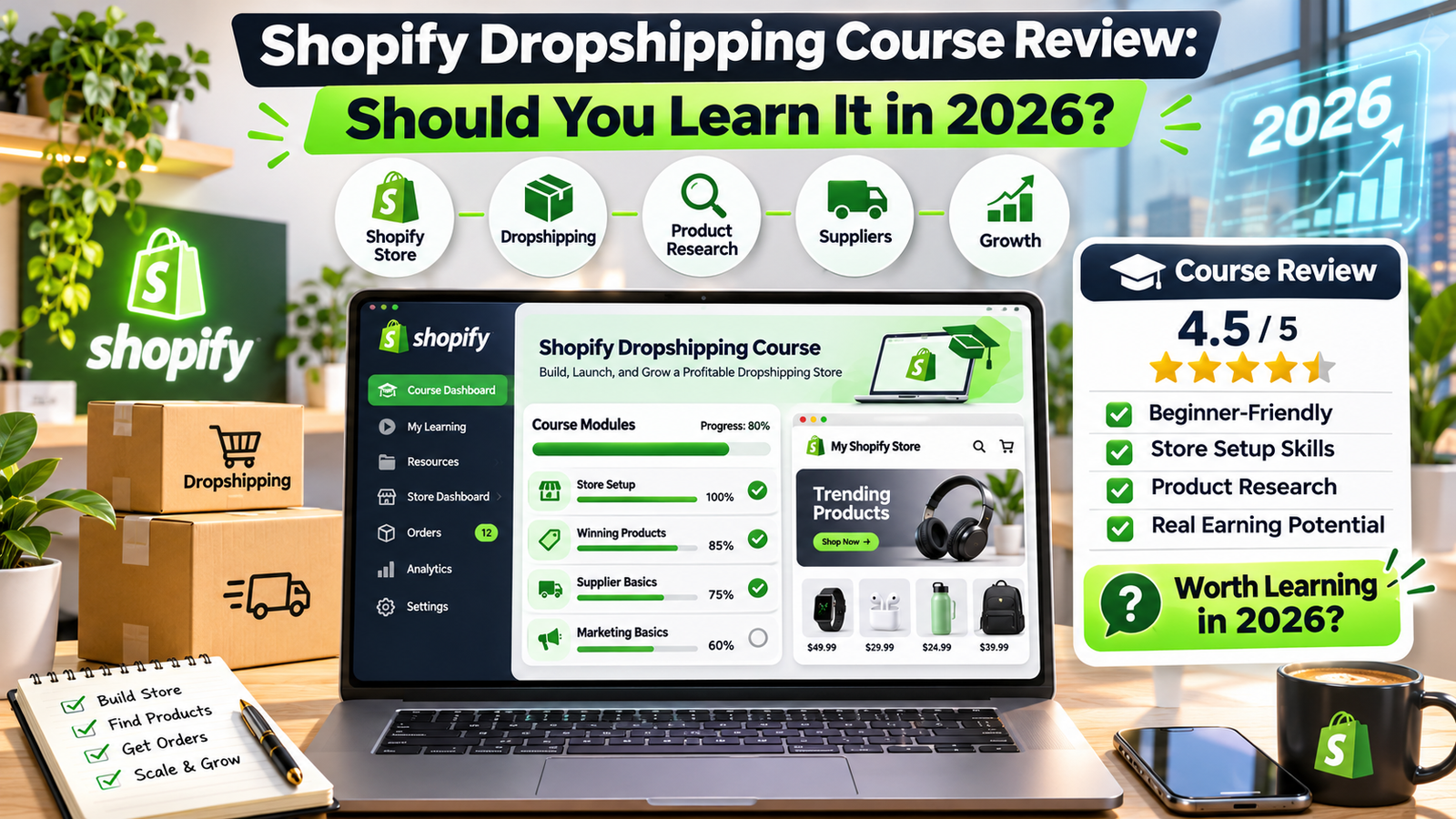
Shopify Dropshipping Course Review: Should You Learn It in 2026?
Introduction
You want to start an online business, but Shopify dropshipping courses leave you with more questions than answers. Some focus on building a store, while others promise quick sales after finding a “winning product.”
Should you pay for training, learn through free lessons, or choose a different skill first?
This Shopify dropshipping course review explains what useful training should include, which costs beginners often overlook, and what learners in Pakistan should check before enrolling.
Yes, learning Shopify dropshipping can be worthwhile in 2026 if you want to understand ecommerce and can practise responsibly. A paid course is worth considering when it provides clear lessons, practical projects, and useful feedback. Completing it does not guarantee a profitable business.
This guide evaluates the course category rather than claiming firsthand experience with a specific provider.
Table of Contents
- What Is a Shopify Dropshipping Course?
- Should Beginners Learn It in 2026?
- What Should a Good Course Include?
- Shopify Dropshipping Course Review: How to Evaluate Your Options
- Costs and Payment Issues for Beginners in Pakistan
- Free Lessons vs Paid Training
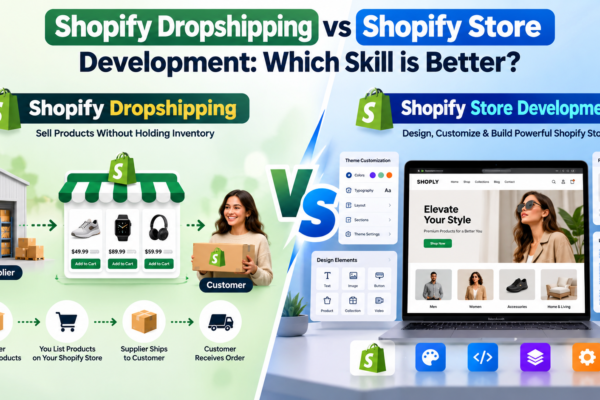
- Dropshipping vs Shopify Store Development
- A Practical Learning Roadmap
- Final Verdict
- Frequently Asked Questions
What Is a Shopify Dropshipping Course?
Shopify is a platform for creating and managing an online store.
Dropshipping is a method of completing orders where a supplier sends products directly to your customers. You do not keep those products in your own stock. Shopify’s documentation describes this arrangement as buying from a third-party supplier who ships to the customer. Dropshipping
A Shopify dropshipping course should teach you how to connect these parts into a working business.
For example, imagine a beginner in Bahawalpur creates a store selling desk accessories. A customer orders a laptop stand, and the supplier ships it directly to that customer.
The store owner still needs to manage the offer, customer communication, delivery expectations, and business costs.
Should Beginners Learn It in 2026?
Learning dropshipping can help you understand how online retail works. You practise choosing products, creating product pages, comparing suppliers, and measuring whether sales cover your expenses.
These skills can also support other ecommerce work. However, you should separate learning the model from spending money to launch a business.
You can explore the basics before committing to subscriptions, advertising, or a paid course.
What Makes It Worth Learning?
A useful course can help you:
- Follow a clear learning sequence.
- Build and improve a sample store.
- Understand supplier and delivery risks.
- Calculate costs before setting prices.
- Learn how to test ideas and review results.
What Makes It Challenging?
You depend on suppliers for product quality, stock availability, and shipping. You also need to give customers accurate information.
Shopify advises merchants to assess suppliers, check product quality, and publish clear shipping and refund information. A course should address these responsibilities alongside store setup. Dropshipping
What Should a Good Course Include?
Store Setup and Product Pages
Look for lessons covering products, collections, navigation, mobile layouts, and checkout settings.
The instructor should explain why each choice matters. Adding a product is useful practice, but writing an accurate description and making delivery information easy to find are also important.
Product and Supplier Research
A useful course should teach evaluation rather than encourage copying trending products.
You should learn to check:
- Which customer problem a product solves.
- Supplier reliability and communication.
- Product quality through samples.
- Delivery times to the intended market.
- Return arrangements and total costs.
“Winning product” should never be treated as a promise of sales.
Pricing and Business Costs
A course should explain the difference between revenue, the money received from sales, and profit, the amount remaining after expenses.
Shopify’s pricing guidance says merchants should account for marketing, subscriptions, and transaction fees when setting product prices. Pricing your products
Consider this hypothetical example:
| Item | Amount |
|---|---|
| Selling price | PKR 4,000 |
| Supplier product cost | PKR 2,000 |
| Shipping cost | PKR 350 |
| Advertising cost per sale | PKR 800 |
| Payment and other variable charges | PKR 150 |
| Amount remaining | PKR 700 |
That PKR 700 is before fixed expenses, refunds, returns, and applicable taxes. These figures illustrate a calculation; they are not expected results.
Marketing and Measurement
Training should explain how customers might discover your store through content, advertising, or other channels.
It should also teach you to measure results. For example, conversion rate means the percentage of visitors who complete an action, such as purchasing.
Practical Projects and Feedback
Look for assignments that produce a complete sample store, a supplier comparison, and a basic cost sheet.
Feedback should explain what needs improvement. A collection of videos alone may leave beginners unsure whether their work is ready.
Shopify Dropshipping Course Review: How to Evaluate Your Options
Before enrolling, assess the course using this checklist:
| Check | What to look for |
|---|---|
| Syllabus | Specific topics arranged in a sensible order |
| Sample lesson | Clear explanations you can follow |
| Instructor’s work | Relevant demonstrations and explained decisions |
| Assignments | Tasks you complete independently |
| Support | Clear details about questions and project reviews |
| Updates | A stated approach to changing tools and platform features |
| Terms | Written access, refund, and extra-charge conditions |
Ask how much of the course covers business operations. A programme that mainly demonstrates product importing may not prepare you for delivery problems or pricing decisions.
Also examine reviews carefully. Detailed feedback about teaching and support is more useful than a short comment saying the course was “amazing.”
Avoid choosing solely because of income screenshots or pressure to pay immediately.
Costs and Payment Issues for Beginners in Pakistan
Calculate More Than the Course Fee
Depending on your approach, expenses may include:
- Shopify subscription charges.
- A domain name.
- Optional paid apps.
- Product samples.
- Marketing and advertising.
- Supplier payments.
- Refunds and returned orders.
Ask which tools are essential and which are optional. Check current charges directly with each provider before purchasing.
You also need to understand cash flow: when you must pay suppliers and when customer payments become available to you.
Check Payments Before Building Around Them
As checked in November 2026, Pakistan is not listed among Shopify Payments’ supported countries. Shopify directs businesses in unsupported countries to third-party payment providers. Supported countries for Shopify Payments
A payment gateway is a service that processes customer payments. Before choosing one, verify its merchant eligibility, required documents, charges, supported currencies, and payout arrangements.
A provider accepting your customers’ cards does not automatically mean it will approve your business or pay into your available account. A Pakistan-focused course should explain how to verify these details.
Free Lessons vs Paid Training
Free lessons are a sensible starting point when you are exploring dropshipping. Shopify provides dropshipping documentation and learning resources you can use to understand the model. Shopify
Paid training may add value through structure, relevant examples, assignments, and feedback.
Choose based on the problem you need solved:
- Need basic understanding? Start with free resources.
- Struggling to organise your learning? Consider structured training.
- Unable to assess your work? Look for project reviews.
- Unsure about payments or suppliers? Seek training that addresses your intended market.
Paying more does not automatically mean receiving better teaching.
Dropshipping vs Shopify Store Development
These paths share some skills, but their responsibilities differ.
| Factor | Running a dropshipping store | Developing stores for clients |
|---|---|---|
| Main work | Selling products and managing orders | Building stores to agreed requirements |
| Income source | Product sales after expenses | Fees for delivered services |
| Main responsibilities | Suppliers, marketing, customers, and refunds | Store quality, deadlines, and revisions |
| Portfolio example | A sample retail store and operating plan | A sample store demonstrating development skills |
If your budget is limited and your goal is freelancing, store development may be a practical starting point. It allows you to focus on delivering a service before taking on the costs of your own retail business.
Neither path guarantees customers or income.
A Practical Learning Roadmap
- Understand the business model. Learn how orders, supplier payments, and refunds work.
- Choose one customer group. Build your practice around a specific audience.
- Create a sample store. Focus on clear pages and easy navigation.
- Compare suppliers. Check samples, delivery arrangements, and communication.
- Build a cost sheet. Include variable and fixed expenses.
- Verify payment access. Confirm eligibility before relying on a provider.
- Review before launching. Test the customer journey and identify gaps.
Treat these as learning stages rather than a fixed timeline for earning.
Final Verdict: Should You Learn It in 2026?
The conclusion of this Shopify dropshipping course review is that the subject can be worth learning, but the value of paid training depends on its depth, support, and fit with your goals.
Choose a course that teaches practical store skills and the responsibilities of running a business. Start with free lessons, check payment access, and understand the full costs before committing money.
Frequently Asked Questions
What should a Shopify dropshipping course review cover?
It should examine the syllabus, teaching, projects, support, extra costs, and refund terms. It should also state whether the reviewer has taken the course.
Can beginners in Pakistan learn Shopify dropshipping?
Yes. Beginners can learn the skills, but launching requires checking payment access, suppliers, delivery arrangements, and costs for the intended market.
Does completing a course guarantee sales?
No. Sales depend on factors including demand, pricing, customer trust, marketing, and delivery performance.
Do I need paid apps to start learning?
Not necessarily. Ask which course assignments require paid tools and whether suitable free options are available.
Should I learn dropshipping or store development first?
Choose according to your goal. Store development focuses on providing a service, while dropshipping involves operating a retail business.

You may also like
Shopify vs Etsy: Which is Better for Beginners in Pakistan?